Riverbank Arachnid Attack
The Ballad of the Last DragonThe Riverbank Arachnid Attack is a crisis of survival and allegiance that transforms a private moment between Sylvaine and Jaromir into a desperate fight against a swarm of monstrous Arachnida. Its decisive consequence is Jaromir’s venomous injury: he holds the creatures away from Sylvaine long enough for Neith and Cadoc to arrive, but collapses in the river before Cadoc’s treatment stabilizes him.
Causes and Background
The attack begins with a warning that reaches the travelers before the creatures become visible. A low hum moving through the trees, punctuated by a repeated click-click, makes Jaromir freeze and abruptly abandon his intimacy with Sylvaine. His urgency is immediate: he forces his clothing back into place, gives Sylvaine her boots, and orders her to leave before the danger fully emerges. The sound therefore functions as both alarm and reversal, replacing closeness with the practical demands of survival.
The threat appears in a nearby clearing as dozens of monsters roughly the size of ponies. They move like giant spiders, but their bodies are protected by bluish-black armor that gleams like black moonstone; long, spiked tails flick behind them, and their pincers snap in a rhythmic clicking threat. The creatures’ design makes them more than ordinary wildlife. Their armored bodies, coordinated advance, and venomous attack place them among the dangerous monstrous forces the expedition must survive rather than simply evade.
What Happens
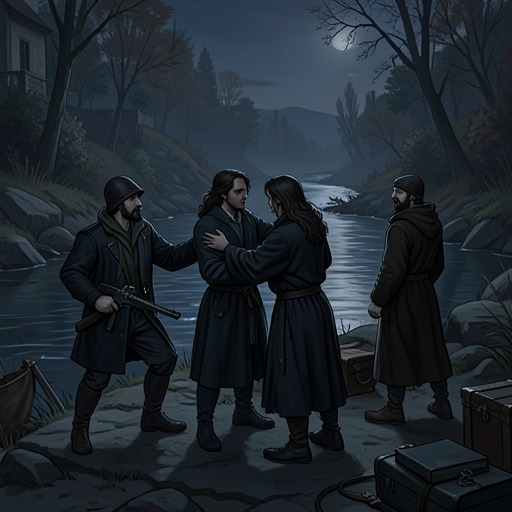
Jaromir raises his sword and positions himself between the swarm and Sylvaine. He tells her that he cannot hold the creatures off forever, but his stance makes the nature of his choice clear: he treats her escape as the priority even while facing overwhelming odds. Sylvaine understands that remaining may distract him, yet leaving would abandon him to enemies he cannot defeat alone. Her hesitation is not indecision without stakes; either choice risks Jaromir’s life.
Sylvaine climbs a tree to gain distance and a better angle, then watches Jaromir fight. He spins and slashes with precision, narrowly avoiding the creatures’ heavy spiked tails and felling several of them. From the branch, Sylvaine turns stones into improvised weapons, striking a beast that approaches Jaromir from the flank and wounding another when her first attack lands against its shining exoskeleton. She calls for Neith and Cadoc until her throat grows hoarse, continuing to throw rocks even as the combat closes around Jaromir.
The battle wears Jaromir down. After Sylvaine runs out of stones, he cries out, and she descends rapidly enough to scrape her knees and palms. Four creatures remain when she finds him standing in the river, breathing laboriously. A wide gash cuts across his thigh, and blood blooms into the rushing water; he favors the injured leg and struggles to remain upright. When the monsters are distracted by Sylvaine’s arrival, Jaromir seizes the opening, cleaving the tails from two of them with a fast sword stroke.
Jaromir cannot continue. His sword slips from his grasp as his knees buckle, and Sylvaine catches both the weapon and his failing body, guiding him to the opposite bank so that he lies partly on the shore and partly in the shallows. She raises his heavy sword and places herself in front of him, prepared to make a final attempt despite having no weapon suited to her strength. The scene turns protection into a shared action: Jaromir first shields Sylvaine, and when he falls, Sylvaine takes his place as his shield.
Neith and Cadoc arrive before the remaining creatures can finish the attack. A whistle cuts through the air, followed by an arrow striking one monster in the neck. Cadoc fires again, hitting another between the plates of armor along its back, while Neith enters the water and drives her sword through the skull of the last creature, pinning it to the riverbed. Their arrival does not erase the danger; it completes the rescue at the point where Jaromir and Sylvaine have exhausted their available means.
Injury and Treatment
Jaromir’s collapse initially makes his survival uncertain. His body trembles, his eyes roll back, and his breathing slows. Cadoc examines his dilated pupils and recognizes that his body is shutting down. Neith tears open Jaromir’s trouser leg, revealing skin around the wound already turned yellowish purple, an abnormal discoloration that signals the venom’s rapid effect rather than an ordinary fresh injury.
Cadoc pours an amber liquid from a stout round vial over the gash. The substance steams and hisses against Jaromir’s skin, producing pain severe enough to draw a muffled growl from him, yet the treatment is necessary. Jaromir then drinks from the vial as Sylvaine steadies him and speaks to him, while Cadoc puts the emptied container away and prepares for the next stage of care. The attack thus reveals Cadoc’s practical value as a healer: the party survives not only through weapons and courage but also through a remedy prepared before the emergency occurred.
Neith urges the group to return to camp before the fever dreams begin. Her warning carries additional weight because she has previously suffered a venom-induced fever herself. She explains that without Cadoc they would face more than nightmares, and identifies the preparation as sepsis oil brewed before it was needed. The aftermath therefore connects Jaromir’s wound to an earlier experience of venom and establishes the attack as part of a recurring danger rather than an isolated accident.
Social and Historical Stakes
Although the immediate danger is physical, the attack belongs to a world shaped by older violence and unequal protection. The party’s encounter with the Arachnida occurs against a history in which human and dwarven records cast their own peoples as heroes opposing the ancient elves, while elven texts and sacred structures were destroyed during The Unification, remembered among elves as The Great Loss. The survival of elven history through spoken transmission is itself presented as an act of resistance, because Sylvaine’s father preserved knowledge of the ancient elven alphabet and the past after written archives had been erased.
That historical imbalance has practical consequences in the present. Elves were barred from holding titles, including land, and those who refused to surrender their property and move into cities subject to searches and curfews could be declared fugitives. Humans were then granted licenses to hunt fugitive elves for a fee, turning persecution into an organized practice in which even body parts could become trophies. Elves who escaped faced expensive and limited passage to safer shores; Sylvaine recalls that her family could afford only one boarding pass, forcing her to leave her parents behind while imprisonment or worse threatened them. The riverbank fight consequently gains an additional dimension: Sylvaine is not merely a vulnerable traveler protected by Jaromir, but an elf carrying the consequences of a displaced people into a landscape where danger is both monstrous and political.
The wider expedition also encounters other legacies of violence. The corpse-eater nest presents flesh-eating beasts with mottled gray, almost humanoid bodies, jagged teeth, and sloe-black eyes, creatures whose presence turns a forest edge into a scene of ecological horror. Elsewhere, a hidden room contains four barrels of black powder alongside aged dwarven whiskey and wine from the Western Isles. The material is especially charged because saltpeter was outlawed after the dwarven alliance with humans during The Great Loss, when explosive weapons had been used to defeat the elves and were later judged inhumane. These discoveries connect the Arachnida attack to a broader pattern: threats are not detached from history but emerge within environments marked by war, abandonment, and the unequal distribution of danger.
Narrative Significance
The attack’s structure repeatedly reverses the expected roles of protector and protected. Jaromir begins as the armed guardian, placing himself between Sylvaine and the swarm and insisting that she flee. Sylvaine initially lacks the strength and training to meet the creatures directly, yet she refuses passive escape: she climbs for a better position, throws stones at monsters attacking Jaromir’s flank, summons Neith and Cadoc, and finally descends into the river when his injury makes abandonment impossible. Once his sword falls from his hand, she catches it and stands between his weakened body and the advancing creatures. The episode therefore makes loyalty visible as action rather than declaration, with each character’s protection of the other becoming a successive phase of the same struggle.
The scene also turns its own violence into potential story. While shielding Jaromir, Sylvaine recognizes that there is a ballad in the moment, though she regrets being unable to write it. That thought does not lessen the immediate terror, but it frames survival as something that may later be preserved through artistic memory. The attack is thus both an ordeal and a nascent legend: a private act of devotion, a nearly fatal battle, and an experience whose emotional shape can be transformed into narrative.
Cadoc’s preexisting remedy supplies the final counterpoint to heroic combat. Weapons kill the creatures, but preparation and knowledge save Jaromir after the battle. The amber treatment is painful, and Neith’s warning about fever dreams makes clear that stabilization is not the same as recovery. Even so, the party’s return to camp becomes the necessary continuation of the rescue, extending the event beyond the moment when the last Arachnida is pinned beneath the river water. The Riverbank Arachnid Attack therefore joins courage, improvised resistance, collective rescue, historical trauma, and the fragile work of healing in one concentrated crisis.